A new patio, driveway, or pool deck changes how your home looks and how your family uses it. When homeowners compare pavers versus concrete, the right answer is rarely about choosing the lowest initial price. It is about selecting a surface that fits the architecture of the home, handles Southern California heat, performs around water, and continues to look polished after years of entertaining, parking, and daily use.
Concrete can be a smart, clean-lined solution. Pavers offer exceptional design flexibility and straightforward repair. Both can become beautiful, durable parts of a luxury outdoor living space when they are designed, prepared, and installed correctly. The better choice depends on where the surface will go and what you expect from it over time.
Pavers Versus Concrete: The Core Difference
Concrete is poured as a continuous slab, then finished with a chosen texture, color, or pattern. It creates a unified surface that works well for modern patios, walkways, and driveways. Decorative options such as broom finishes, exposed aggregate, integral color, and stamped patterns can give concrete a more customized appearance.
Pavers are individual units, commonly made from concrete, natural stone, or porcelain, installed over a carefully prepared base. Their joints create a modular system rather than one large slab. That distinction matters. Pavers can accommodate minor movement and allow individual sections to be removed and reset if settlement, access needs, or damage occurs.
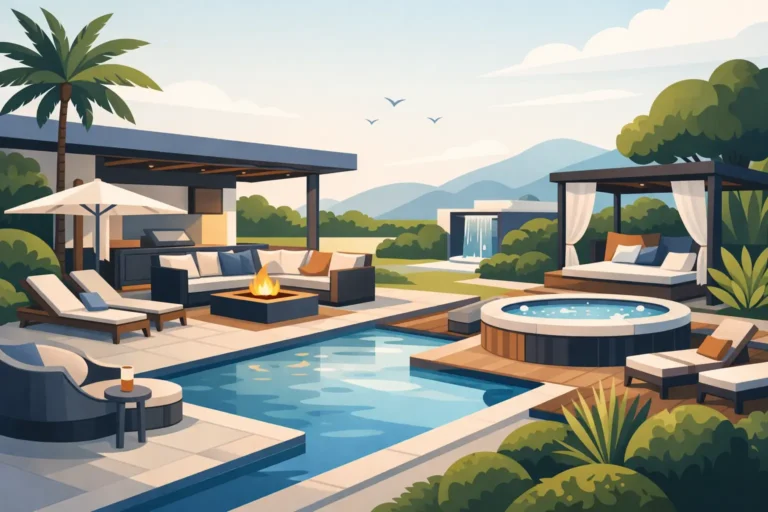
For a homeowner building a complete backyard retreat, pavers often provide a more layered, architectural look around a pool, covered patio, outdoor kitchen, and fire feature. Concrete may be the better match for a broad, minimal surface where a monolithic appearance is part of the design vision.
Appearance and Design Flexibility
Pavers give homeowners more control over visual detail. They are available in a wide range of sizes, colors, edge profiles, and laying patterns. A large-format paver can complement a sleek contemporary pool, while a tumbled paver can bring warmth to a Mediterranean or Spanish-style property. Borders, contrasting bands, and transitions between outdoor zones are easier to create without making the space feel busy.
That flexibility is especially valuable in properties with several hardscape areas. The pool deck, patio, walkways, grilling area, and side-yard access can share a coordinated material palette while still serving different functions. Pavers can also be cut and shaped precisely around curved pool walls, spas, planters, drains, and outdoor kitchen islands.
Concrete offers a different kind of design strength: visual calm. A properly designed concrete patio can feel expansive and refined, particularly with a smooth or lightly textured finish and carefully placed control joints. Stamped concrete can imitate stone or pavers, although it does not offer the same depth, individual-unit variation, or repair flexibility as the real material.
Cost: Initial Price Versus Long-Term Ownership
Concrete usually costs less upfront than a premium paver installation, particularly for a simple broom-finished slab. Pavers require more material, more base preparation, edge restraints, bedding sand, joint sand, cutting, and installation labor. Natural stone and porcelain pavers can raise the investment further.
However, the initial price is only one part of the decision. A cracked concrete slab is difficult to make invisible. Repairs may leave a visible color or texture difference, and resurfacing is not a permanent solution for every structural or drainage issue. If the slab shifts substantially, replacement may be the cleanest answer.
With pavers, a damaged or settled area can often be lifted, the base corrected, and the original units reinstalled. This is also useful when underground plumbing, electrical lines, or pool equipment connections require future access. The ability to repair a section rather than demolish an entire surface can make pavers a strong long-term investment.
Neither material should be selected on price alone. A low-cost installation with poor grading, weak base compaction, or inadequate drainage can become expensive quickly. High-quality craftsmanship begins below the finished surface.
Performance in Southern California Heat
Southern California sunshine is a major part of outdoor living, but it is hard on hardscape. Dark materials can become uncomfortable under bare feet, especially around a pool. Light-colored pavers and lighter concrete finishes generally reflect more heat and create a more comfortable deck surface.
Pavers have joints that can help accommodate small amounts of expansion and movement. This can be helpful in areas exposed to regular temperature swings and direct sun. Concrete expands and contracts as well, which is why properly placed control joints are essential. Those joints encourage cracking to occur in planned locations, but they do not eliminate the possibility of cracks.
For pool decks, surface texture deserves as much attention as color. A deck should offer reliable traction without being overly rough on bare feet. The right finish depends on the material, slope, drainage plan, and whether the area will be exposed to splash-out from a pool, spa, Baja shelf, or waterfall.
Repair, Maintenance, and Daily Use
Concrete maintenance is relatively simple: keep the surface clean, address stains promptly, and reseal decorative finishes as needed. Yet concrete is vulnerable to cracking, especially when the subgrade moves, tree roots interfere, water collects beneath the slab, or the original installation lacks adequate reinforcement and joint planning.
Pavers require periodic attention to joint sand and may benefit from sealing, depending on the product and desired appearance. Weeds can appear in neglected joints, though proper installation, quality joint sand, and regular care significantly reduce that issue. Efflorescence, a whitish mineral residue, can also occur on concrete-based products and is usually manageable with appropriate cleaning methods.
For driveways, both options must be designed for vehicle loads. A driveway is not simply a patio with cars on it. Proper base depth, compaction, edge restraints for pavers, concrete thickness, reinforcement, drainage, and access conditions all influence long-term performance. This is where experienced site evaluation matters more than a generic material recommendation.
Where Pavers Make the Most Sense
Pavers are often the preferred choice for pool decks, entertaining patios, outdoor kitchens, walkways, and high-visibility driveways. Their finished appearance can elevate curb appeal and create a resort-style setting that feels intentional from every angle.
They are particularly practical when a project includes complex geometry, multiple elevations, or future service access. Around a custom pool, pavers can tie together coping, decking, planters, a fire feature, and a covered living area into one elegant space. They also allow a homeowner to replace a small damaged area without disrupting the rest of the backyard.
A premium paver installation requires disciplined preparation. The excavation must reach stable material, the base must be placed and compacted correctly, the finished surface must drain properly, and the edges must be securely restrained. The visible paver is only as reliable as the system underneath it.
Where Concrete Is the Better Choice
Concrete is an excellent option for homeowners who prefer a clean, continuous surface and a more controlled upfront budget. It can work especially well for a large backyard patio, a side yard, or a driveway where a simple finish complements the home’s exterior.
It is also a logical choice when the design calls for a poured-in-place look that pavers would interrupt. A modern property may benefit from large concrete panels, subtle joint lines, and a soft neutral color that lets landscaping, pool water, and architectural lighting take center stage.
The key is to treat concrete as a finished construction system, not a quick pour. Proper grading, appropriate thickness, reinforcement where required, planned joints, and a finish suited to the surface’s use all protect the investment. A flawless result is built through preparation and careful execution, not just the day the concrete arrives.
Drainage Should Decide More Than You Think
Water management is one of the most overlooked parts of the pavers versus concrete decision. Pool decks, patios, and driveways must direct water away from the home, avoid standing puddles, and work with existing drainage conditions. Poor drainage can stain surfaces, undermine bases, create slippery areas, and contribute to settlement.
A professional design-build evaluation considers finished elevations, thresholds, retaining conditions, roof runoff, planters, drains, and the relationship between new hardscape and existing structures. This is especially critical when a project includes a new pool or spa, where deck drainage must be coordinated with the overall construction plan.
High Level Services approaches hardscape as part of the complete outdoor environment, not as an isolated surface. That perspective helps homeowners create a personal oasis with materials that look refined, perform reliably, and support the property’s long-term value.
Choose the Surface That Supports Your Whole Property
If you want detailed patterns, repair flexibility, and a premium resort-style finish, pavers are often worth the higher initial investment. If you prefer a streamlined surface, have a clear plan for joint placement, and want to manage initial costs, professionally installed concrete can be an excellent choice.
The best material is the one that supports your home’s style, your outdoor lifestyle, and the demands of the site. A thoughtful consultation can turn that decision from a surface-level comparison into a lasting improvement you will appreciate every time you step outside.